
Monthly Archives: September 2010

Love Shack

There is another shack in Baraboo besides Aldo Leopold’s (see the 9/18/10 “Land Ethic” post) that is well-known to environmentalists: the shack from which George Archibald, co-founder of International Crane Foundation, wooed Tex.  On September 25, my daughter and I heard George tell stories about those days as he opened the “George and Tex” exhibit at ICF.  It was a love story, at least on the part of Tex, a female Whooping Crane.

The Crane Foundation has a captive breeding program to help increase the numbers of Whooping Cranes.  The whoopers, along with Sandhill Cranes, are the only cranes native to North America and their numbers at mid-century were pitiful.  The beautiful, white birds were almost extinct.  Tex came to ICF already imprinted on humans, meaning that she failed to identify with cranes and only wanted to be with humans.  Particularly dark-haired, male humans.  Especially George.  She chased away any females who came near them.

In order to put Tex in the mood to “breed” (be artificially inseminated), George built a small hut inside her pen and stayed with her during the breeding season, acting, for all practical purposes, as her mate.  Sometimes he read and got work done inside the tiny wooden house but he was always available to dance with Tex, as all cranes like to do, to establish their bond.  In 1982, Tex laid an egg that hatched into a chick named Gee Whiz that, to this day,continues to contribute to a healthy Whooping Crane gene pool.

You may have heard of ultralight aircraft being used to teach birds migration.  That is where some of the ICF cranes go, to Necedah National Wildlife Refuge a bit north of ICF in Wisconsin, to live in the wetlands and learn a migration route to Florida.  Being as it’s Wisconsin, land of the Cheese Heads, the eleven Whooping Crane chicks raised at ICF this year were all named after cheeses, such as Ricotta, hatched on my birthday, June 10.  (There are also seven whoopers that hatched in the wild at Necedah and two survived, to be joined by those hatched at ICF.)
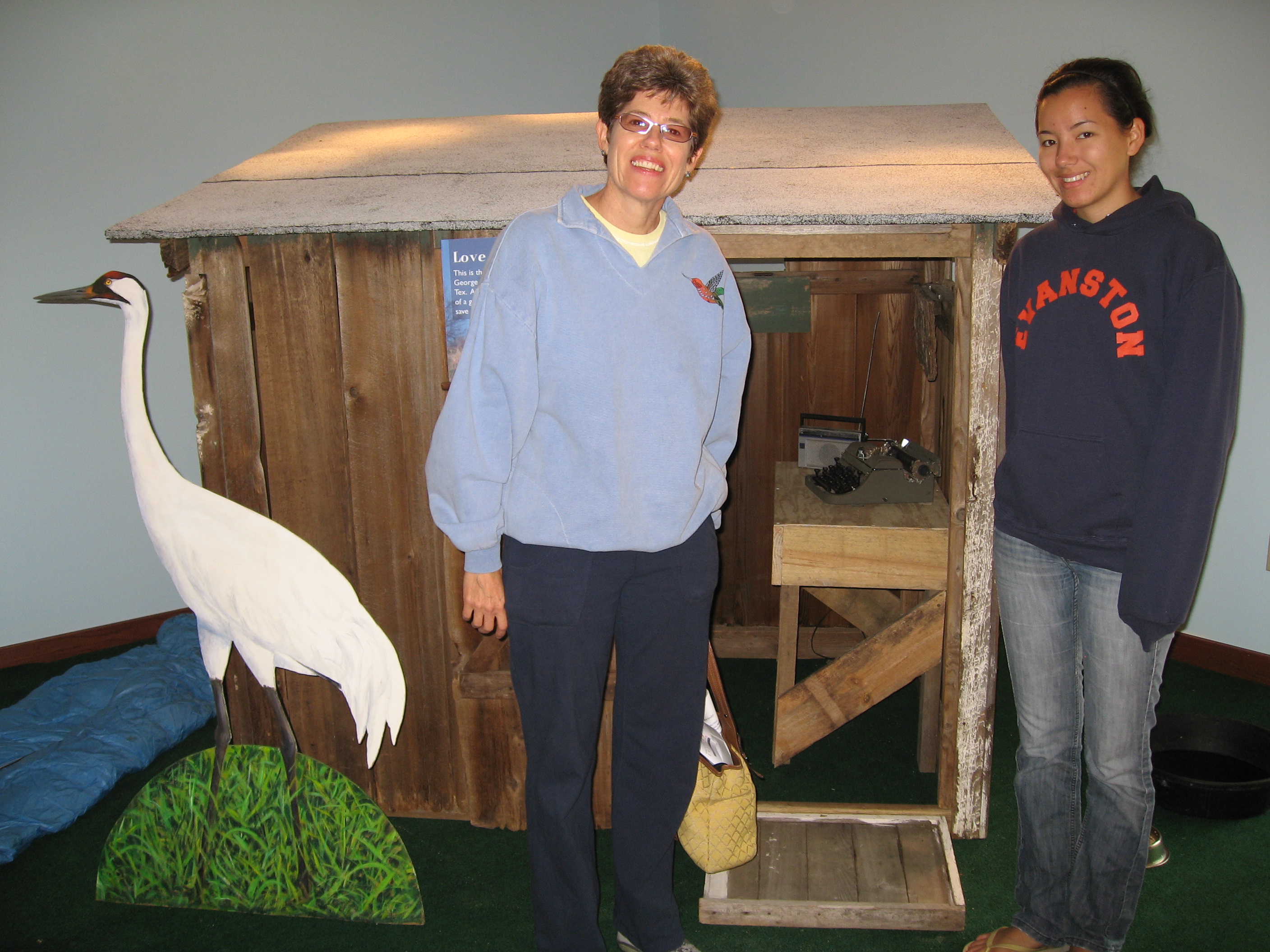
 

George Archibald's shack at International Crane Foundation


Female Whooping Crane at ICF


All the chicks at ICF are now raised by aviculturists, interns, and volunteers dressed in white outfits with a crane-head puppet on one hand, speaking not a word.  No more imprinting on humans!  With no more need for George’s shack, it is on display as part of the “George and Tex” exhibit–a testimony of Tex’s devotion to George and, even more so, of the Crane Foundation’s devotion to the protection and continuation of cranes.
A Square Inch of Quiet

New kinds of listening

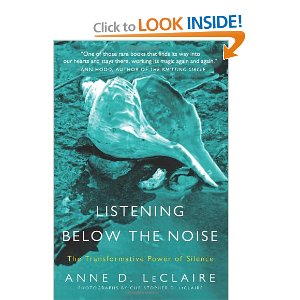
I am learning lately to listen more carefully and preserve  peace and quiet when I can.  I recommend Listening Below the Noise by Anne LeClaire and One Square Inch of Silence by Gordon Hempton and John Grossman because those authors have helped me listen deeper, more frequently, and with fresh ears.


For Gordon Hempton, listening is his practice and silence his therapy.  Unlike a monk in silent retreat, Hempton goes forth to take full measure of his adversary—noise pollution.  And he does it while crossing the country, from Washington state to Washington, D.C.,  in a 1964 Volkswagen van he calls “Vee Dub,” a car that is a character in its own right.

Hempton’s other constant companion is his sound-level meter with which he takes a noise profile of the United States from one end to the other, with many side trips to places recommended to him as quiet.  The results are not good.  Rarely can Hempton find the peace of nature (with its diversity of sounds) for more than a few minutes without the intrusion of man-made noise.  Those pervasive noises from airplanes, cars, and oil rigs can grate on us in ways we don’t even realize, adding an undertone of stress to an already stressed-out country.  As Henry David Thoreau, the author of Walden, noticed, “Men have become the tools of their tools.”  The racket those tools are making is drowning out our opportunities to pause, appreciate, regroup, and reflect.

Gordon Hempton is an Emmy award-winning acoustic ecologist who records sounds for everything from movies to video games.  His book is called One Square Inch of Silence: One Man’s Search for Natural Silence in a Noisy World (2009).  He even includes a CD of nature sounds with his book, which, sadly, was missing in my library copy.  His listeners have let him know that they find joy, solace, and healing in the music of birds, water, and trees that he records—soundscapes where humans felt at home for thousands of years.  Soundscapes now almost impossible to find.

Part memoir and part manifesto, the writing in this book can be a bit rambling at times, just like his trip.  Yet there is something compelling about the story and his efforts to inform—and ultimately confront—federal officials who, on paper anyway, are mandated to protect citizens from unmitigated noise.  His main pleas are to the park service and the Federal Aviation Authority.  If we could restrict airplane travel over the national parks, that would help preserve the very peace and quiet that visitors seek there.  Hempton is not hopeful about winning that battle because it is too late.  Both commercial flights and sightseeing flights go over the Grand Canyon, for instance.

But Hempton has staked a small claim to silence and that is the one square inch of the book title, a red stone he placed on a log in the Olympic National Park in Washington state.  That area of the northwestern United States has very few planes flying over it and he would like to keep it that way.  He invites anyone at the Park to hike to the stone and leave him a message in a jar he put there.  He likes to know that he has allies in his often lonely fight to be conscious about protecting natural silence, the silence that we don’t  even know we’re missing till we get under the rumbling threshold of noise that has become the norm.

The book by Anne LeClaire is Listening Below the Noise: A Meditation on the Practice of Silence (2009).  For almost two decades now, LeClaire has taken two days of silence a month.  Doing so, she has found a source of renewal and peace that helps her remain true to herself in the midst of a busy life.  I was fortunate to spend a weekend with her and take time to listen to myself and nature more attentively than ever before.  Both Hempton and LeClaire remind us to pay attention, both within and without, and treasure the silence.

Anne LeClaire’s website is http://www.anneleclaire.com.  Look for her Sacred Silence workshops.  Also see http://www.onesquareinch.org and, if you can, take a walk in the Hoh Rainforest, find Hempton’s stone, and sit a spell.

Land Ethic

How did a hard-boiled forester, hunter, professor, and fisherman become one of our most eloquent spokesmen for loving and caring for the land? Aldo Leopold (1887-1948) was a pioneer conservationist who is well known for his book of essays, A Sand County Almanac.  He credits a wolf in Arizona and a shack in Wisconsin for his personal transformation and the evolution of his ideas.

As a young forester in Arizona, Leopold killed a wolf.  In a section of his book called “Thinking Like a Mountain,” he remembered, “We reached the old wolf in time to watch a fierce green fire dying in her eyes.  I realized then, and have known ever since, that there was something new to me in those eyes–something known only to her and to the mountain.  I was young then, and full of trigger-itch; I thought that because fewer wolves meant more deer, that no wolves would mean hunters’ paradise.  But after seeing the green fire die, I sensed that neither the wolf nor the mountain agreed with such a view.”  Part of his transformation in the Southwest was that he ceased to merely act on his environment and began to act with it, listening to wolf and mountain, tree and stream.

“We abuse land because we regard it as a commodity belonging to us.  When we see land as a community to which we belong, we may begin to use it with love and respect.”  To enter the community Leopold made his own, at least on weekends when he could get away from his work at the University of Wisconsin, I drove to the Aldo Leopold Center near Baraboo, Wisconsin (www.aldoleopold.org).  At the Center, a gorgeous pine and stone building with two kinds of geothermal systems, I talked with an intern named Anna and she gave me directions to the secluded Shack and loaned me a bicycle to get there.  Following a paved road and then a grassy path, I arrived at the place that inspired so many of the essays in A Sand County Almanac.

When Aldo, his wife Estella, and their five children bought their property in 1935, it was a sandy, over-farmed field near the Wisconsin River, with only an old chicken coop left on it.  The family shoveled out the dirt and manure and made that coop livable for their many visits from Madison.  (One son built an outhouse they called the Parthenon.)  For Aldo, it was an experiment in renewing the land.  He and his family planted thousands of trees and wildflowers, making it a lush, green place.  A place to listen to the land.

“A land ethic,” Leopold wrote, “reflects a conviction of individual responsibility for the health of the land.  Health is the capacity of the land for self-renewal.  Conservation is our effort to understand and preserve this capacity.”  He did that with his own hands, and died trying to extinguish a brush fire on his neighbor’s land.  His daughter, Nina, still lives near the Shack and has kept the green fire burning.

In 2012, look for the documentary on PBS, “Green Fire: Aldo Leopold and the Land Ethic in the 21st Century.”

I biked to the shack where Leopold wrote Sand County Almanac