Geese at the End of Summer

Canada Geese

Canada Geese

It’s supper time and there’s nobody on the lake.  Just me and some geese.

I count 31 of them.  Now and then they honk or rise up and flap their wings a bit, but mostly they just float.  I’m not sure how they do it, but they float in two straight lines.  Are they practicing formations for migration?  I want to paddle closer to them but I don’t want them to be disturbed and fly away.

I steer clear of the birds and go north to the lily pads.  They look tattered and wind-blown this time of year.  The best of summer is over, I guess.  I pluck out a Coke can and some plastic debris and throw it in the back of the boat to discard at home.  Then I allow myself to drift back towards our dock.

Suddenly the geese are on the move.  First one group takes off in a flurry of splashing wings and then another.  I expect them to form Vs as they fly away but they fall into lines again and undulate northeast over the pine trees.

I am reminded that the whole summer has gone by and I’ve hardly written a thing.  Sadly, we had a dog sicken with Lyme disease and die.  Happily, we had a daughter get married.  Plus we moved.  Now I want to find my way back to my desk and get some lines down on paper, let my thoughts fly.

Here are some parting “words” from geese in flight: http://ibc.lynxeds.com/sound/canada-goose-branta-canadensis/calls-pair-flight

September reflections

September reflections

Ecology and the Road

A good place to walk

A good place to walk

It seems that the more we improve our roads the less hospitable they are to people.

I remember hearing an engineer at a town hall meeting reveal his proposal for an “improved” road by our summer home.  Our neighbor, Mrs. Miller, stood up and said, “Over my dead body!  I will lay down in front of your bulldozers before I let you turn our road into a four-lane highway.”  As a child hearing her words, I pictured her soft body on the earth, gray hair nestled in fallen pine needles, as heavy machinery roared toward her.  I believed her—that she would lay down her life to save the forest—and I have come to understand her passion.  She loved that land like life itself.

Mrs. Miller fell in love with the north woods of Minnesota by tending it for all of her years.  For me, I fell in love with trees.  I am happiest when I am climbing a tree, or at least sitting by one.  Every trail I walked and every fort I made out of meadow grass brought me closer to the land.  I was wooed by the peace and beauty I found there.  It got harder to go play outside as I got older, but now I am trying to make it a priority.  Just as our mothers told us, I am telling myself: go out and play.  And here’s another childhood mantra: stop, look, and listen.  I try not to rush through my nature walks, but, rather, take time to open my senses.

To know the land is, usually, to love it.  I believe that loving nature is the beginning of conserving it.  Caring about it makes me want to care for it.  It seems to me that ecology is an inside job. “Environment” may be defined as something outside myself, but the seed of environmentalism is found within me.  How do I care for myself and how do I care for the planet?  Mother Earth offers me her talents and, in turn, I use what small gifts I have to protect, enhance, and appreciate her. 

Mrs. Miller brought her passion.  My father brought research about road regulations that he’d gathered at a university library to prove that the requirement for the width of the road was not as the engineer had claimed.  My family and our neighbors loved that land and we showed it.  The road was repaved but remained two lanes, and trees and meadows were saved.  And it is still a good road to walk or bicycle along.

By the road in Minnesota

By the road in Minnesota


Wonder Walk: Hiking for Health

Hiking in Costa Rica

Hiking in Costa Rica

The first Wednesday of April is National Walking Day.  This is one way the American Heart Association promotes habits that keep our heart happy.  Whether you walk alone or with others, the idea is to get moving.  If you can connect with nature while you’re outside, so much the better.

Buddhist author Thich Nhat Hanh leads walking meditations at his retreat center among the sunflowers of Bordeaux, France.  In Peace Is Every Step he reminds us, “Be aware of the contact between your feet and the Earth.  Walk as if you are kissing the Earth with your feet.”

Librarian Ann Vogl and English teacher Cheryl Gorsuch decided to hike the Ice Age Trail–all 1000 miles of it.  It took them five years, getting together on weekends to do a bit at a time.  They often talked while they walked and got to know each other very well.  They also got to know thirty counties of Wisconsin as they followed the edge of the last glacier!  Upon achieving their goal this month, Gorsuch commented, “I think you see so much of Wisconsin at a personal level, foot by foot, step by step.”

Mark Hirsch is another inspired Wisconsinite.  Every day for a year, he walked to a 163-year-old Bur Oak, took a picture of it, and got to know it very well.  It became “That Tree” project, completed just two weeks ago.  (See www.facebook.com/photosofthattree.)  People who saw his photos posted online got to know the oak, too, and shared their stories of special trees.   So whether we hike a thousand miles or walk to the same place every day, there are benefits from the physical exercise and the connections we make.

Though I like taking sociable walks with friends, I pay more attention to flora and fauna if I go quietly by myself.  I can pause and watch birds to my heart’s content or lean against a tree until I have set down roots alongside it.  For heart health, a rapid pace is best, and I do like race-walking.  But for peace of mind, I like to pause and appreciate my surroundings.

Kathleen Dean Moore of Oregon writes in Wild Comfort: The Solace of Nature of walking along a river by the Cascade Mountains.  She couldn’t help but take her stress with her.  “Already,” she says, “just a few hours into the weekend, time feels short.  I hurry to relax before I have to go back to my complicated life.”  She pauses to watch the river, a tortoiseshell butterfly lands on her arm, and her awareness shifts.

“Lucky.  If I hadn’t stopped to watch the river, if I hadn’t worked up a sweat in this unlikely sun, if I hadn’t pushed my sleeves up past my elbows, I might never have discovered how to drink in the peace of this time and place, every warm drop.”  Moore continues, “This is what a human brings to the world–the ability to take notice, to be grateful and glad, glad for the river swinging by, for the sun warming my shoulders, for the breeze lifting the hairs on a butterfly’s back.”

May you get lucky on April 3 and every day.  Don’t hurry to relax.  Take your time and have a heartfelt walk.


Porcupine Discovery

North American Porcupine

North American Porcupine

I was face-to-face with a porcupine that lay so still in the crook of some pine branches that I wondered if it was dead.  Thrilled to see wildlife, I was also startled and scrambled back down the tree as fast as I could go.

I didn’t know porcupines could be that big and I didn’t even know they climbed trees!  Maybe it looked so big because each one has about 30,000 quills.  And maybe it was sleeping during the day because porcupines are nocturnal.  They climb trees with their long claws, eat pine needles, and then, apparently, take a nap.

I was nine and I’d crossed the road from our northern Minnesota house to sit in my favorite spot by Goose Lake.  The prickly rodent must have liked it, too, perched in the tree with an excellent view of the water.  If I’d known more about it’s kind, I would have had the confidence to climb back up the tree and take a second look.

Jamie Sams (Medicine Cards, p. 85) says, “Porcupine is a gentle, loving creature, and non-aggressive.  When fear is not present, it is possible to feed a Porcupine by hand and never get stuck by its quills.”  Searching on Word Press, I, indeed, saw a porcupine named Thistle fed by hand.  (The video has had millions of hits, because it is pretty darn adorable.  Plus, the critter has hiccups.)  Thistle could be an ambassador for what Sams calls its special medicine: “the power of faith and trust.”  This tells me I have some things to learn from these prickly critters.

I just hope we don’t run into one with our dogs.

Quills in a dog.

Quills in a dog.

Quills ready for defense.

Quills ready for defense.

Skiing in Beauty

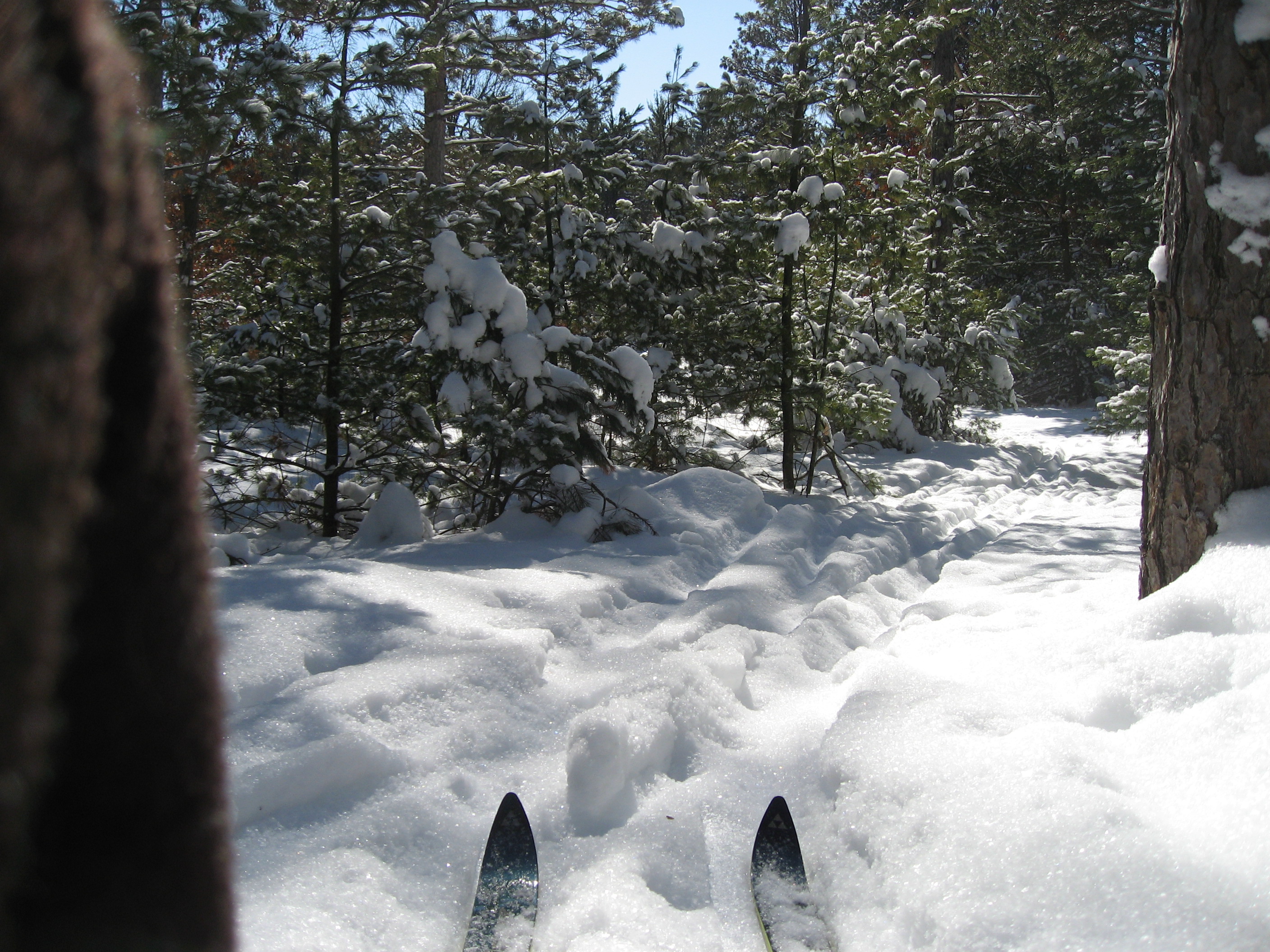
Cross-country skiing in Marquette County

Cross-country skiing in Marquette County

It was a good day to be out skiing.  Imagine yourself so small you could play on a cottonball.  That’s what the snow was like in central Wisconsin last weekend.  Not the best conditions for speed-gliding, but perfect for playing in a cushy wonderland of fluff.

Access to the trail near our cabin was through the snow-draped limbs of White Pines–their needles soft, too, as I brushed by them and entered their domain.  A hush lay all around me.  All I had to do was slide along on my skis and look around.  I saw tracks of deer and rabbits.  The sky was blue and frost sparkled and everything was fresh.  With every little breeze, snow from the branches above sifted down on me and I was refreshed.

The magic of the winter woods put me in mind of the Navajo prayer, asking “in harmony may I walk”:

With beauty before me may I walk.

With beauty behind me may I walk.

With beauty below me may I walk.

With beauty above me may I walk.

With beauty all around me may I walk.

I am restored in beauty.

Link

Muir and Me in Marquette County

A new version of my blog post about John Muir Memorial Park appeared in Orion Magazine’s “Place Where I Live.”  I like visiting the park to appreciate John Muir and his hard work preserving beautiful places in America.  Drive north of Madison, Wisconsin to the little town of Montello and you will find the park nearby.

To Go: Our First Day in Costa Rica

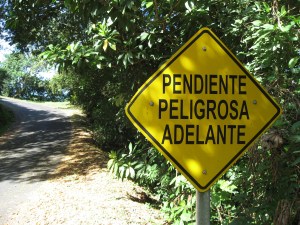
Dangerous curves

Dangerous slope

They talk fast here.  Las palabras bump against me like so many fish.  I am lost in a sea of words.

More specifically, we are lost on Highway One in Central America.  My husband pulls over our rented Daihatsu Terios mini-SUV and I approach un hombre outside a café (only they call them sodas here).  My fledgling Spanish takes a flying leap: “Por favor, ¿donde esta Limonal?”

The man peers at me through his glasses, points north and says a bunch of words.

“Oh, Limonal is that way?”  I have run out of Spanish.

Thankfully, my new roadside savior keeps it simple: “San Gerardo aqui,” he says, pointing down.

           “Ah, aqui.”  This is San Gerardo.  We have not yet reached Limonal where we will turn west toward the beaches.  It is hard to know these things because the road signs here do not say where we are, only where we’re going.

Saint Roadman says something else and I am reluctant to say I don’t understand for fear he will explain using more Spanish and it will be awkward.  So I look at him until he is done talking, say gracias and return to the car.

Donald consults the map

Donald consults the map

At Limonal, Donald and I stop and have lunch at a soda.  My chicken taco has more chicken than I can eat.  How do I ask to take the rest with me?

“Yo tomo los pollos a mi casa,” I stutter, forming my hands into what I hope looks like a container for my food.

The waiter, inexplicably named Kenneth, responds in English, “To go?”

“Si.”

“In English: ‘to go.’  In Spanish, we say ‘para [blah blah],’” he explains.  Para means “for” but the rest I don’t know what he’s saying.  It’s an aural blur.  But Kenneth is looking at me expectantly so I try to say the phrase.  It is not right.  He says it again.  I try again.  And again.

Kenneth pulls out his pen and writes down three words for me, but the middle word looks like a fraction: 1/c.  He seems to pronounce it “che.”  Could it be “yc”?  And the last word looks like “bar.”  I am more lost than ever.  Finally the waiter releases me, his inept pupil, giving me the slip of paper with the algebraic code for take-out food.

Back in the car, I look in my Spanish-English dictionary for every permutation I can think of for “to go” or “take-out” and find nothing.  Nor do I find any Spanish word spelled “yc.”  Bar simply means bar or pub.  I may have to stick to hand gestures.

Donald and I get our room at Hotel Cantarana and go to the beach to catch the sunset.  A tropical pink sun touches the Pacific as we arrive on the wide sands of Playa Grande.  Surfers tuck their boards under their arms and head for home, silhouetted against the pink sky.  I stand in the ocean, waves pummeling my knees and shells bumping my feet.

Thus ends our first day in Costa Rica and our first day ever in a Spanish-speaking country.  I pick up a little unicorn horn of a shell and take it with me.  To go.

Playa Grande, Dec. 3, 2012

Playa Grande, Dec. 3, 2012

Note: both my daughter Emily and fellow writer Peggy Wolff tell me that the waiter’s term for “to go” is para llevar (to carry).  Perhaps Kenneth was trying to write it phonetically for me.  Thank you to patient Spanish-speakers everywhere!
Listening with Leopold

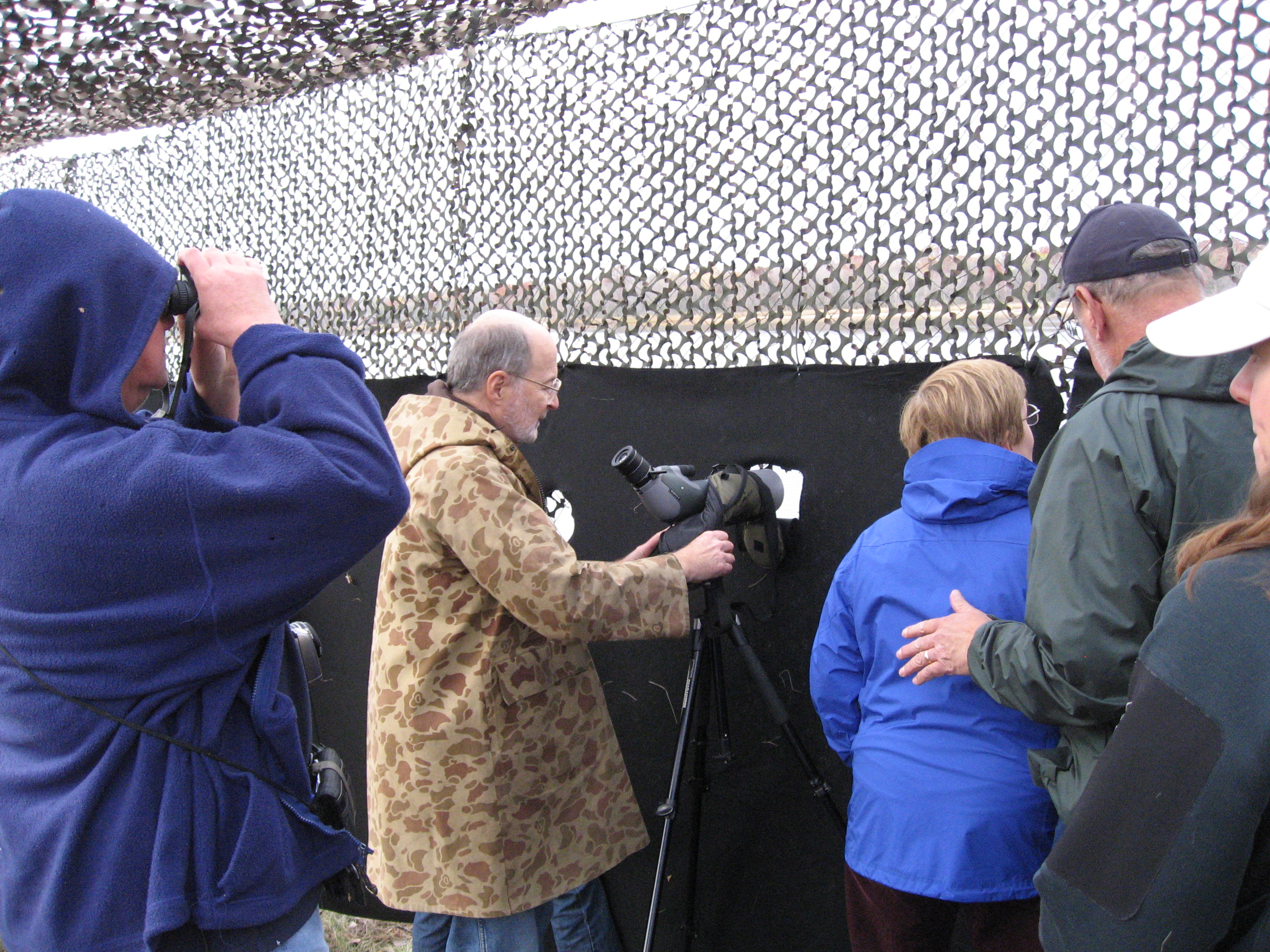
In the blind

Many of the Greater Sandhill Cranes in Wisconsin gather each autumn on the sandbars of the Wisconsin River.  Happily, one of their favorite spots can be easily viewed near the Aldo Leopold Shack in Baraboo.  Not so happily, rain was predicted for the day I was to go see them.  Skies were gray and the wind was chilly as I drove to the Leopold Center.  But as a group of us hiked through the crunchy leaves to the blind along the river, patches of blue sky appeared.  It didn’t rain.

Instead, we got a rainbow.  Protected from the wind by the fabric of the blind, I wasn’t cold or the least uncomfortable, though we stood there for two hours.  With the streaks of the partial rainbow over the east bank of the river and the first hints of sunset behind us, it was a good place to be on an October day, whether we saw birds or not.

Wisconsin River

And we did see birds.  Geese flew in formations overhead.  A Bald Eagle flew by.  Sandhill Cranes came by twos and threes to gather on the sandbanks of the river.  I didn’t have a lens powerful enough to get a good picture, but I did have binoculars and I could sure hear their calls.  There was much hoopla as they arrived, bugling back and forth as they settled themselves among the dozen cranes already there.  Our guide, Stanley Temple, professor emeritus of University of Wisconsin and a scholar of bird conservation, called it “social chatter.”  The birds were talking with each other.

According to the fossil record, cranes are of ancient design.  In “Marshland Elegy” Leopold observed that “our appreciation of the crane grows with the slow unraveling of earthly history.  His tribe, we now know, stems out of the remote Eocene.  The other members of the fauna in which he originated are long since entombed within the hills.  When we hear his call we hear no mere bird.  We hear the trumpet in the orchestra of evolution.  He is the symbol of our untamable past, of that incredible sweep of millennia which underlies and conditions the daily affairs of birds and men.”

Each morning at the Shack, Leopold liked to keep notes on which bird species he heard and when he heard them.  From these notes, Dr. Temple recreated the likely soundscape of 1940s Wisconsin at this site.  In the bird blind, I heard some of them for myself, grateful to witness some of the enduring rituals of the season.

See (and hear) Temples’s work here: http://www.loe.org/shows/segments.html?programID=12-P13-00039&segmentID=7.      

Stanley Temple at the blind with a group from the Leopold Center

The Bird That Hit the Window

I gave the bird some water in hopes it would recover.

TEXTING WITH MY DAUGHTER TO IDENTIFY A HERMIT THRUSH

Bird half conscious on the deck,

Hit a window.  Broke its neck?

No!  It moves and stands alone.

I take a photo with my phone,

Send it to my daughter Emily.

She’s the birder in the family.

Hi, sweetie, think it’s Sparrow?

“No, Mom, beak’s too narrow.”

Pipit has a narrow bill.

“But it has a slimmer build.”

I see brown spots on its neck.

“Cannot tell from your pic.”

Warbler, Finch, Nuthatch, Thrasher?

Junco, Creeper, Chat, Gnatcatcher?

So many bird names I could blurt,

But she must get back to work.

After many guesses offered glibly,

I go consult the book of Sibley.

Not one to fret about proper names for each plant and animal I see, I nonetheless find that it helps me pay attention to details when I use The Sibley Book of Birds or some other resource as I try to identify something.  Puzzling it out can be gratifying.  It also helps me develop new habits.  Novelist Harold Brodkey wrote in his memoir, “At one time I was interested in bird watching, and I noticed that when I saw a bird for the first time I couldn’t really see it, because I had no formal arrangement, no sense of pattern for it.  I couldn’t remember it clearly, either.  But once I identified the bird, the drawings in bird books and my own sense of order arranged the image and made it clearer to me, and I never forgot it.”

I was glad to discuss this bird with my daughter, even in the limited way of texting on a cell phone, so I could learn about it.  I was gladder still when it recovered enough to rustle its feathers and fly away.  I will remember the thrush and its brief visit.

Thrush song: http://www.youtube.com/watch?v=w9vHS6JdHog

50th Anniversary of “Silent Spring”

Reaction to Rachel Carson’s research

Of “The 25 Greatest Science Books of All Time” listed in Discover Magazine http://discovermagazine.com/2006/dec/25-greatest-science-books/article_view?b_start:int=1&page=2, Silent Spring by Rachel Carson is #16.  That book, credited with sparking the environmental movement, was published September 27, 1962, meaning its 50th anniversary is coming up.  Rachel Louise Carson (May 27, 1907- April 14, 1964), the marine biologist and naturalist who wrote the book, has since been both credited and blamed for just about everything under the sun.  At the very least, we can say that many bird species that would have gone silent are still singing today.  That is worth celebrating.

The book is a valuable but difficult read due to the density of technical information with which Carson shored up her arguments.  Yet, it caught on in her day and was selected for the Book-of-the-Month Club.  President Kennedy considered it a wake-up call, as did so many others, and authorized studies of the effects of chemicals, leading to increased regulation.  DDT was found to kill a broad spectrum of insects and then work its way up the food chain.  I remember being amazed, back in the 60s, that a bug spray was causing birds to produce thin-shelled eggs, thus threatening the survival of Bald Eagles.  DDT was  banned in the United States for agricultural use.

Such bans and regulations did not sit well with corporations that produced synthetic pesticides.  They attacked Rachel Carson and Silent Spring, which served to give the book publicity.  As TIME Magazine reported in 1999, “In their ugly campaign to reduce a brave scientist’s protests to a matter of public relations, the chemical interests had only increased public awareness.”  Even now, some people blame Carson for malaria and mosquitoes in general, as if DDT could have wiped out an insect known for developing immunity to insecticides.

“Carson was not arguing for banning all pesticides,” notes John Wargo of Yale University, who spent six months going through 117 boxes of Carson’s personal files. “She was simply arguing against the broad-scale prophylactic application that would lead to widespread contamination and exposure. Her arguments follow a train of logic and a narrative that would be extremely useful today.” (Lauren Peeples in HuffPost Green)

When Rachel was a child, her mother used to take her on walks, awakening her sense of wonder.  Carson urged us to continue to foster that appreciation of nature in her book The Sense of Wonder.  She closed that book with these words: “The lasting pleasures of contact with the natural world are not reserved for scientists but are available to anyone who will place himself under the influence of earth, sea and sky and their amazing life.”  Noticing bird song today is a good place to start.

Two of Carson’s books