Category Archives: Planet Earth

Planet Walker

"A great companion on your walk..." (p. 148)

Two things about John Francis are stunning to consider: He chose to not speak for 17 years and chose to walk everywhere for 22 years.  His parents worried for his sanity, but eventually saw that he was living by his values.  His wandering reminds me of Johnny Appleseed planting all those trees, and his silence reminds me of Anne LeClaire who chooses to be silent two days a month.

A TED talk brought him to my attention and I found his book Planetwalker (2008, Washington, D.C.: National Geographic) in Evanston Public Library.  When John Francis was a young man in 1971, he witnessed an oil spill from two tankers that collided under the Golden Gate Bridge.He decided that he didn’t want to depend on things that depended on oil, so he gave up riding in motorized vehicles.  He walked everywhere, often playing his banjo as he went.  To complete his college education, he walked from California to Southern Oregon State College, then onto Missoula, Montana for a graduate degree, then to Madison, Wisconsin for his Ph.D. in land resources.  Eventually, he crossed the entire country on foot.

His parents stopped wondering about his mental health and started following his accomplishments with pride.  John could only converse with them by notes and hand signs because he gave up talking.  He got all those degrees without saying a word!  He gave up talking for a day so he could listen better.  The day turned into a year and the year lasted until April 22, 1990.  “I have chosen Earth Day to begin speaking,” he said, “so that I will remember that now I will be speaking for the environment.” (p. 250)

Dr. Francis said (p. 274), “I think I’d like to refer to myself as an environmental practitioner instead of an environmentalist.  … [P]ractitioner implies becoming and doing something in order to improve.  In the end, I think it’s about learning to live better on Earth.”  In 1991, he was hired by the U.S. government to help draft oil spill regulations.  He also founded an environmental organization, Planetwalker, and developed a curriculum he calls Planetlines.

One of the things he wants to share is that “walking and silence save me.  They not only give me the opportunity to slow down to listen and to watch others; they afford the same opportunity with myself.” (p. 50)  John’s pilgrimage was an individual journey, but its effects rippled far and wide.  I learn from him to walk the planet in new ways.
Reliable Friends

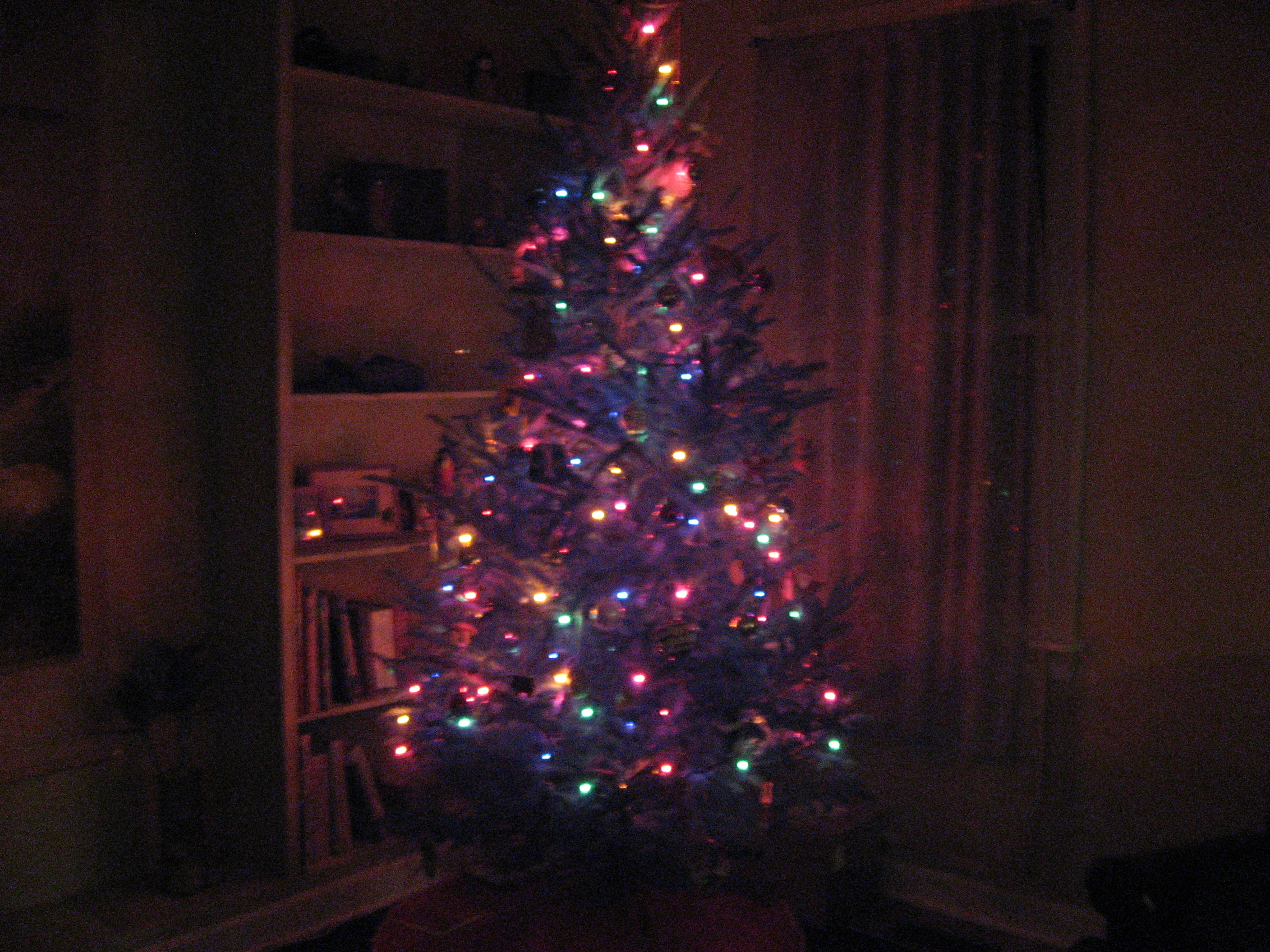
O, Tannenbaum, how lovely are your branches.

You need no introduction to nature.

You are nature.

To nature you return.

Nature holds you every day.

Yet who among us does not need

a reminder of these things?

That is the point of this Of the Earth blog, to remind myself to go outside, to be in nature, to remember what it’s all about.

On this Solstice, I am remembering.  I am watching for babies’ smiles.  I am listening for the voices of my friends and family.  Now I pause to listen, too, to the more quiet ones with the cold, damp bark and the skitter of feathers.  With them, I am “one of the common things,” as poet William Stafford (Allegiances, 1970) said, joining in rejoicing for the lengthening days.

“World, I am your slow guest,

one of the common things

that move in the sun and have

close, reliable friends

in the earth, in the air, in the rock.”

Even in winter, the Hudson River naturalist John Burroughs (John Burroughs America, 1951) made a point of conversing with the plants where he lived.  “Nearly every season I make the acquaintance of one or more new flowers.  It takes years to exhaust the botanical treasures of any one considerable neighborhood,” he wrote.

Like John Muir and Aldo Leopold, Burroughs had a special fondness for conifers and he wrote, “How friendly the pine tree is to man—so docile and available as timber and so warm and protective as shelter!  Its balsam is salve to his wounds, its fragrance is long life to his nostrils; an abiding, perennial tree, tempering the climate, cool as murmuring waters in summer and like a wrapping of fur in winter.”  In thinning the white pines near our cabin, I brought three inside and now I see my friends all around.  As my favorite carol says, how lovely are their branches.

old friend

Of the Earth, By the Earth, and For the Earth

Dr. Seung Heun Lee offered “The Prayer for Peace” at the opening ceremony of the General Assembly of the United Nations on August 28, 2000.  Since he invoked the name of this blog, I share an excerpt here.  Eleven years later, having experienced in the U.S. the ravaging effects of the 9/11/01 attacks, his call for a revolution of the human spirit seems even more fitting.  Here are some of his words for healing our world.

with gratitude together we rise

“I offer this prayer for peace

To declare a revolution

Of the human spirit.

I wish to announce that

It is now time

For all of us to spiritually awaken

And become enlightened,

For the time of the enlightened few is over,

The age of elitist enlightenment has passed.

For how long do you seek to wait for prophets

To come down from mountaintops

And tell us what to do?

We all must become enlightened

To recognize our divinity,

To raise up our consciousness…

We must ourselves become the enlightened ones.

We must realize our Oneness.

I declare that we must all become ‘earthlings’

Of the Earth

And not of any religion, nation or race,

But of this Earth, for this Earth, and by this Earth

To create a lasting peace

On Earth.”

Bodhisattva of the Earth

Back to the Shack

Looking out from the Shack

The final section of A Sand County Almanac (1949) is called “The Outlook.”  In it Aldo Leopold considered various attitudes, from “the farmer for whom the land is still an adversary” to the urban dweller who “is separated from the land by many middlemen, and by innumerable physical gadgets.”  He worried in the 1940s that land had become, for some, merely “the space between cities on which crops grow,” though most people still lived in those rural spaces.  In our time, for the first time, more people in the world live in cities than in the country.

He also worried about the habit of viewing the land as a commodity.  For Leopold–outdoorsman, ecologist, professor of game management–it boiled down to valuing our natural environment for so much more than its economic value.  “It is inconceivable to me that an ethical relation to land can exist without love, respect, admiration,” he wrote.  He saw himself as part of a community, integrally connected to the plants, animals, water, air, and the soil itself.

It was about a year ago that I biked to the Shack where Leopold wrote about the land ethic and practiced its principles.  The building was not open at the time.  (See my September 18, 2010 post.)  I went back last week for two days of Land Ethic Leadership training, with plentiful role models of the love and respect of which Leopold spoke.  We learned in large groups, small groups, and out on the land.  We hiked in silence to a prairie remnant at the top of a Baraboo bluff.  I lay on a slab of ancient red stone and watched the grass and sky.   We also removed invasive plant species around the Leopold Center buildings.  Mostly, we talked about how to talk about conservation and the health of the land.

A highlight for many of us was to go inside the famous Shack at the very end of our training.  It is hard to believe that Aldo, Estella, and their five children stayed inside the tiny, dim space that was once a chicken coop.  Well, they slept on the bunks there, but mostly, I suppose, they were outside–planting the trees and wildflowers I admired from the window of the Shack and generally enjoying their time together in nature.

Leopold knew that our attitudes toward nature are always shifting, as his certainly did.  The land ethic is not a static thing that he could capture in words, because it is evolving.  Being in the woods and prairies, feeling the presence of Aldo’s daughter, Nina Leopold Bradley who died just a few months ago at the age of 93, and warmed by the light of the people at the Center, I was changed. Somehow my outlook from the window of the Shack took me beyond the pines, beyond the Wisconsin River, and back up to the top of that bluff.  I could see for miles.

Gathering at the Shack

“Charlotte’s Web” inspired by animals–and what they produce

Wilbur loves Charlotte.

I’m writing this blog post on the birthday of E.B. White (July 11, 1899- October 1, 1985) and remembering the pure pleasure of reading his 1952 children’s book, Charlotte’s Web.  It turns out that both Elwyn Brooks White and his character, Wilbur, were fond of warm manure, that inextricable aroma and texture of farm life.

A new book by Michael Sims, The Story of Charlotte’s Web: E.B. White’s Eccentric Life in Nature and the Birth of an American Classic, provides a hundred ways in which White connected with nature.  Of course, a book about a spider named Charlotte and a pig named Wilbur began in nature; what is fascinating is how addicted White was to domesticated nature.

He was a shy, quiet, and sometimes depressed person and, though he tried therapy, he found his greatest solace and healing in the barn.  Growing up, his family in Mt. Vernon, New York had stables with horses, pigs, geese, hay, and manure.  Little Elwyn loved watching and listening to the goings-on there and later wrote about himself, “This boy felt for animals a kinship he never felt for people”  (Sims, p. 4).  As an adult, he and his wife, Katharine, bought a farm in Maine where they worked on their writing and editing.  White wrote, “Animals are a weakness with me, and when I got a place in the country I was quite sure animals would appear, and they did” (p. 132).  The Whites raised pigs and chickens and enjoyed watching spiders spin their webs in the doorways of their big, white barn.

In the book, the manure pile was a big part of Wilbur’s world, as it was a big part of White’s experience of country living.  “There is no doubt about it,” he wrote (p. 195), “the basic satisfaction in farming is manure, which always suggests that life can be cyclic and chemically perfect and aromatic and continuous.”

I notice in my own posts on this blog that various forms of manure have come up, including that of turtles and birds.  The truth is that encountering scat is part of being outdoors and gives us clues as to who is doing what and where.  My first chore when I arrive at our cabin is to sweep the guano off the stoop.  Bats sleep in the peak of the covered entry and poop like mad.  Someday I’ll also clean off the robin and phoebe droppings that whitewash the log walls where they build their nests.  Lately, I’ve had to clean off the dock some mounds packed with crunched-up bits of crayfish shell, probably from a raccoon.

As David Gessner wrote in his book, Sick of Nature, nature writers talk a lot about scat, but are supposed to be refined about it.  White put it front and center in his book, starting a draft, before there were any human characters involved, with: “Wilbur was a small, nicely-behaved pig living in a manure pile in the cellar of a barn” (p. 195).  We write what we are called to write, as Charlotte did in her web in order to save Wilbur’s life.

Birth and death, intake and output, animals and manure–you cannot have one without the other.  For White, it was part of “a paean to life, a hymn to the barn, an acceptance of dung” (p. 188).

“A Wrinkle in Time” began in nature

A Wrinkle in Time was one of my favorite books as a child, and I liked it even more when I reread it as an adult.  Central to the tale are three mysterious women

a classic

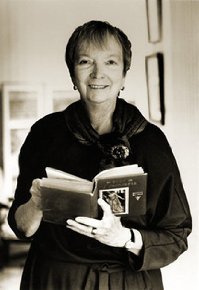
called Mrs. Whatsit, Mrs. Who, and Mrs. Which.  These visitors from beyond time and space disguise themselves, rather poorly, as frumpy old ladies, materializing at crucial moments in the plot.  How did Madeleine L’Engle (1918- 2007), a mother, choir director, and general store clerk, come up with these outlandish ladies?  By letting her mind rest and her imagination spin in the quiet of nature.

Before she made her name as a writer, L’Engle lived in a 200-year-old farmhouse called Crosswicks in Connecticut.  In the midst of her busy life raising children and running a general store, she found a secluded spot in the countryside, a ten-minute walk from her house, and made it her own.  “My special place is a small brook in a green glade, a circle of quiet from which there is no visible sign of human beings,” she wrote (1972).   “The brook wanders through a tunnel of foliage, and the birds sing more sweetly there than anywhere else; or perhaps it is just that when I am at the brook I have time to be aware of them, and I move slowly into a kind of peace that is marvelous.”

In a noisy world, visiting a soothing, quiet place means that “things slowly come back into perspective … and my sense of humor returns,” as L’Engle found.  The quiet of green spaces is restorative to both mind and body.

MRI scans show that the areas of the brain most active when our minds are relaxed and free to wander are the same areas that “light up” when we are engaged in creative work.  Michael Rich of Children’s Hospital in Boston, says, “If our minds are always busy, we may be missing out on creative thinking,” noting that Albert Einstein didn’t devise his theory of relativity in a lab, but on his walks home from work.

Madeleine L’Engle was nurtured by her Circle of Quiet but actually found the inspiration for her wildly creative novel, A Wrinkle in Time, on a camping trip out west.  She reported that she was among “deserts and buttes and leafless mountains, wholly new and alien to me.  And suddenly into my mind came the names, Mrs. Whatsit, Mrs. Who, and Mrs. Which,” the sages who help the main character Meg travel by way of a wrinkle in time to try to rescue her father.

UPDATE: The movie “A Wrinkle in Time” opens March 9, 2018. The roles of Mrs. Whatsit, Mrs. Who, and Mrs. Which will be played by Reese Witherspoon, Mindy Kaling, and Oprah Winfrey. What amazing women to play these characters inspired by the forces of nature! @WrinkleInTime

the author

Written on Stone

511 million-year-old stones in central Wisconsin

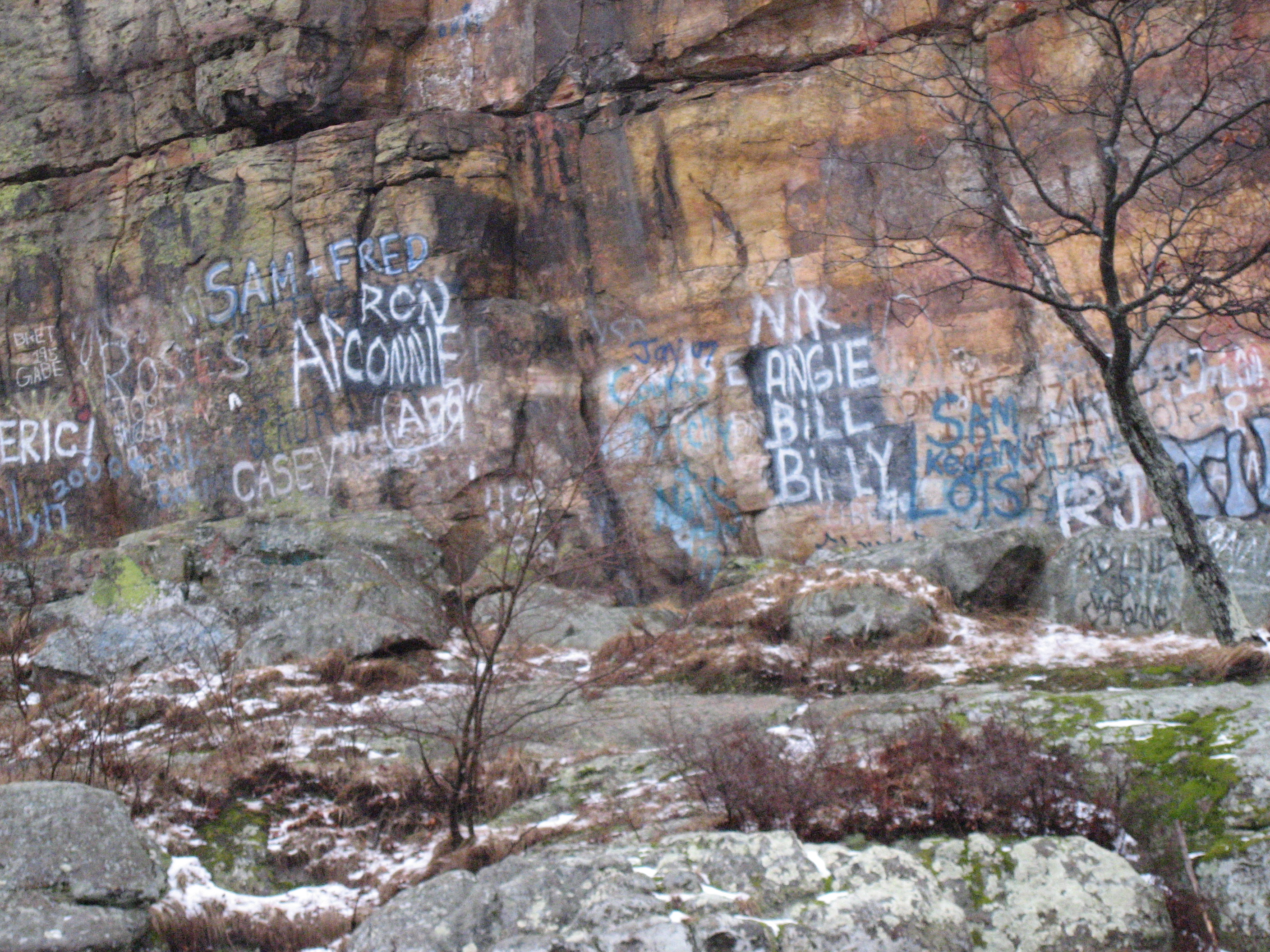
Every time I drive between Wautoma and Tomah, Wisconsin, I admire three things: Necedah Wildlife Refuge, the cranberry bogs, and the Shiprock stone formation that has its own little rest area.  I used to like to stop there and clamber around the rocks, but every year there is more spray painting and litter there, making it more painful than pleasant to observe.

Is graffiti an art form or an act of vandalism?  Artist Terrance Lindall is quoted on Wikipedia as saying that graffiti can be a subversive form of expression that is revolutionary, adding, “People who are oppressed or suppressed need an outlet, so they write on walls–it’s free.”  Having grown up in a small town myself, not unlike this area, I suspect that the spray-painters who leave their names and initials are simply bored or want to somehow leave their mark on the world.

Shiprock Graffiti

My friend, Bill Buchholtz, comments on the practice of defacing areas of natural beauty, saying, “How sad.  Instead of protecting stuff like this, my people are losing more of their history.”  This Cambrian Shiprock formation happens to be just a bit north of the well-known vacation area of the Wisconsins Dells, which is full of even bigger sandstone bluffs, left over from the last ice age.  The ones in the Dells area are mostly protected, including some that have ancient pictographs (rock painting).

Tens of millions of rock art images appear around the world, with the ones in Australia dating back 60,000 years.  “Rock art,” says James Q. Jacobs, an expert on pictographs and petroglyphs, “constitutes the greatest body of evidence of the intellectual life of our ancestors.”  He feels it is important to preserve these graphic records of prehistory.

What are we recording in our current history, and how much of it will survive to tell our tales?  The first image I posted on this blog is an example of the rock art in Boynton Canyon, Arizona.  I was moved when I saw it, so I took a picture of it and shared it with you all.  The spray painting along Highway 21 in Wisconsin?  I just shake my head and keep moving.

Nature as Mentor

What is biomimicry?  The term is made up of the Greek words bios for life and mimesis for imitation.  It is an approach to science and product development that relies on learning from and imitating nature.  This is in stark contrast to our usual practice of forcing nature to do our bidding, usually by way of harsh chemicals, high temperatures and/or intense pressure.  (This is how we synthesize plastics, alloys, and many other products in this industrial age.)

The environmental costs of such brute force technologies are so devastating that scientists, engineers, and manufacturers are looking for alternatives.  Many are asking the question, “How does nature do it?”  For instance, certain plants filter water to purify it; no chlorine needed.  How can we mimic that?

Science writer Janine Benyus described biomimicry in her book by that title as “a new science that studies nature’s models and then imitates or takes inspiration from these designs and processes to solve human problems, e.g., a solar cell inpired by a leaf.”  Nature provides myriad models and possibilities for us to consider.

Biomimicry also uses nature as a measure, a standard to meet in finding what works and what is most sustainable.  An animal or a plant cannot afford to pollute or otherwise ruin its own environment, its home, so it finds low impact methods to survive and thrive.  Why not learn from billions of years of innovation and development (aka evolution)?

Benyus goes a step further and says that nature can be a mentor, which is what I have been thinking about for a few years now.  “Biomimicry,” she writes, “is a new way of viewing and valuing nature.  It introduces an era based not on what we can extract from the natural world, but on what we can learn from it.”

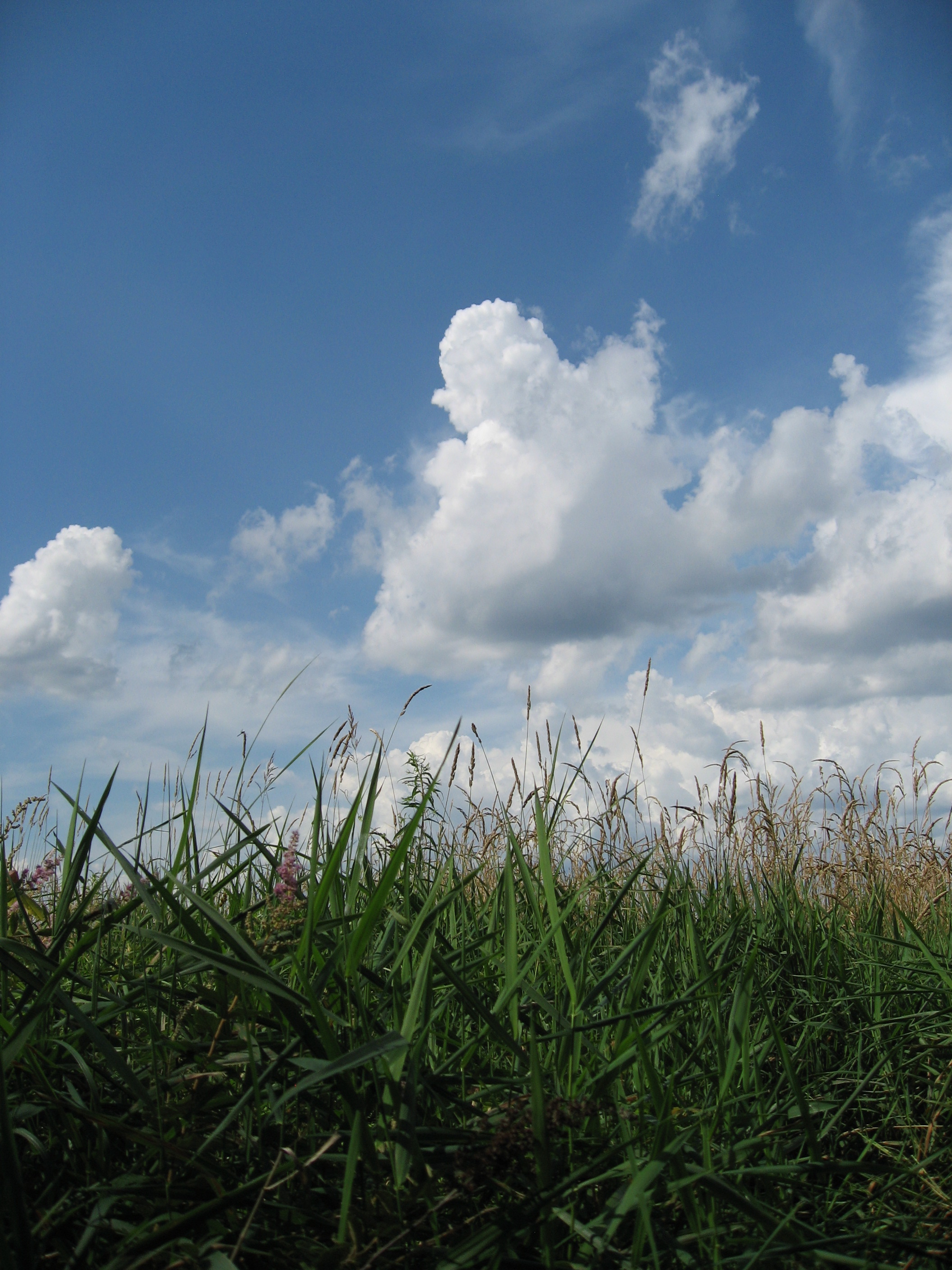
What can we learn from prairies and clouds?

What a concept–working with nature!  This is what Aldo Leopold’s “land ethic” requires.  This is the way many indigenous people live, or were living, not because they were more virtuous but because cooperating with nature is what works in the long run.

My previous post told the story of learning from burrs in order to invent hook-and-loop fasteners, currently used in virtually every household in America.  Now products are being invented based on the self-cleaning properties of lotus leaves and the amazing “stickiness” of gecko feet.  (Those little lizards can run straight up a plate glass window!)  This is in part due to high-powered microscopes that allow us to see such things as the tiny bumps on the leaves of the lotus plant, and in part due to our willingness to pay attention to the intelligence of nature displayed all around us.

What can we learn from trees and insects, water and stone? We’ve just begun to find out.

Have You Thanked a Burr Today?

Dog and burrs

In 1941, a man named George de Mestral went hunting for two weeks in the Swiss mountains.  Switzerland, like many places in the world, has plants with burrs and those burrs stick to anything fuzzy.  By the time George got home, there were so many burrs on his trousers and tangled in the fur of his dog (an Irish Pointer), it took a long time to remove them all.

George got curious.  What made the spiny seedpods grab onto the fur?  De Mestral was an engineer with a scientific mind.  And he had a microscope. (People started developing microscopes in 1590 to examine things too small to see with the naked eye.)  When he looked at a burr under the microscope, he saw that each spine was bent at the end, having what he called in French crochet, which means hook.  The hooks made the burr stick to anything soft that brushed against it—an  ingenious way to scatter the seeds of the burdock plant!

Not only did George admire the plant’s method of seed dispersal, he decided that people could use this same technology, if only he could find a way to manufacture it.  He imagined creating a zipperless zipper and even got a patent for it in 1951.  But it took him many years to invent his version of the burr’s hooks.  He got up at sunrise every morning in his small cabin in Switzerland and tried to figure out how to use nylon, a synthetic fabric, to grab onto velour, a velvety cloth.

De Mestral finally developed a manufacturing process and—voila! Velcro® (a combination of the words velour and crochet) was born.  First, astronauts used it in outer space (very useful in zero gravity), then skiers on their outfits, and pretty soon the new hook-and-loop technology appeared on wallets, clothes, book bags, and shoes.  George de Mestral became a millionaire, moving from his mountain hut to an elegant chateau, all because he learned the secrets of a burr.

One day, when he visited his manufacturing plant in the United States, George gave the bosses there some advice: “If any of your employees ask for a two-week holiday to go hunting, say yes.”  George de Mestral knew that if you go outside and pay attention, you might be surprised by what will stick with you.

This is the first in a series of MS. TREE’S NATURE MYSTERIES, an introduction to biomimicry by Barbara Wolf Terao.

Have You Thanked an Apple Today?

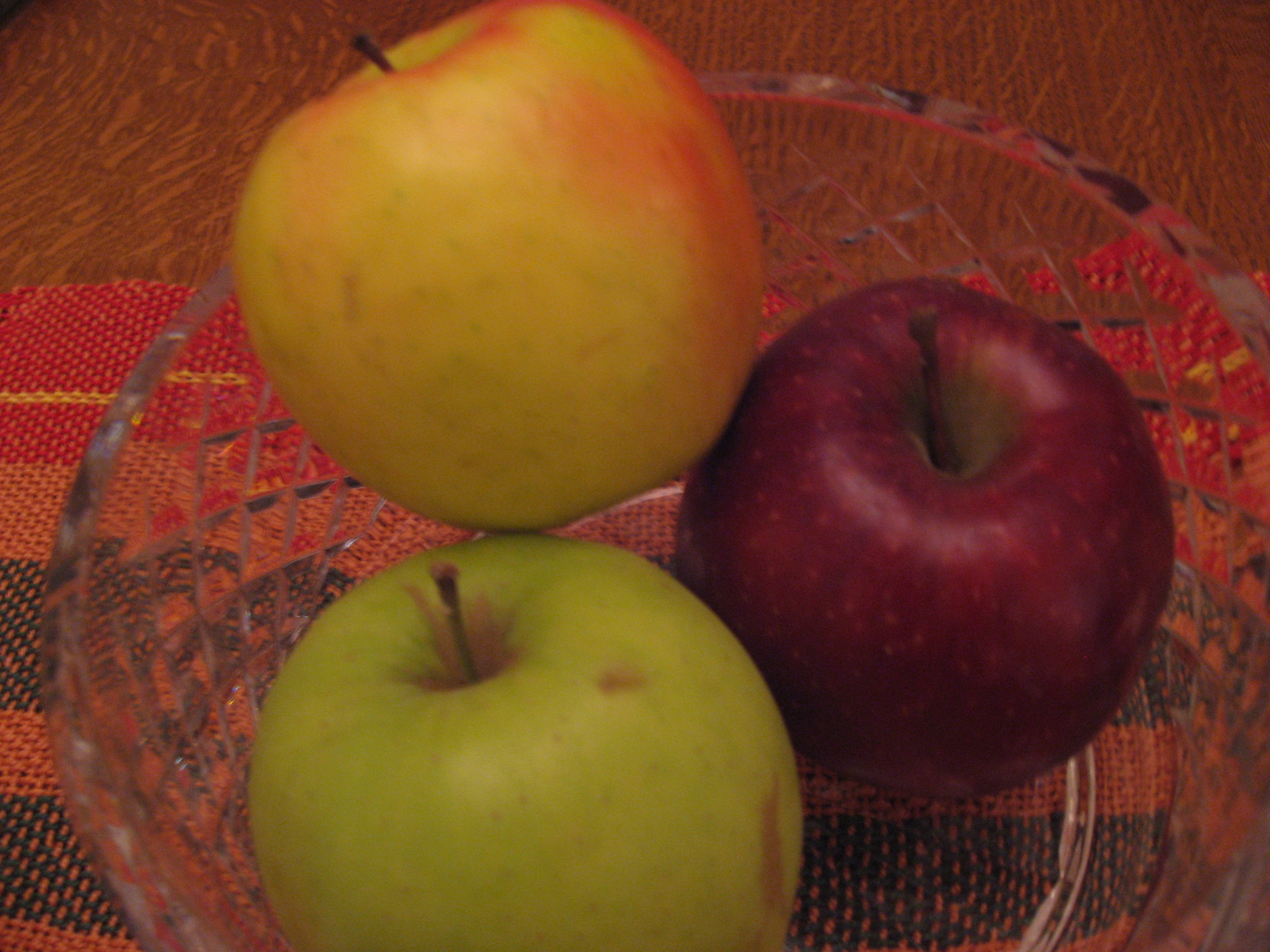
Have a bite!

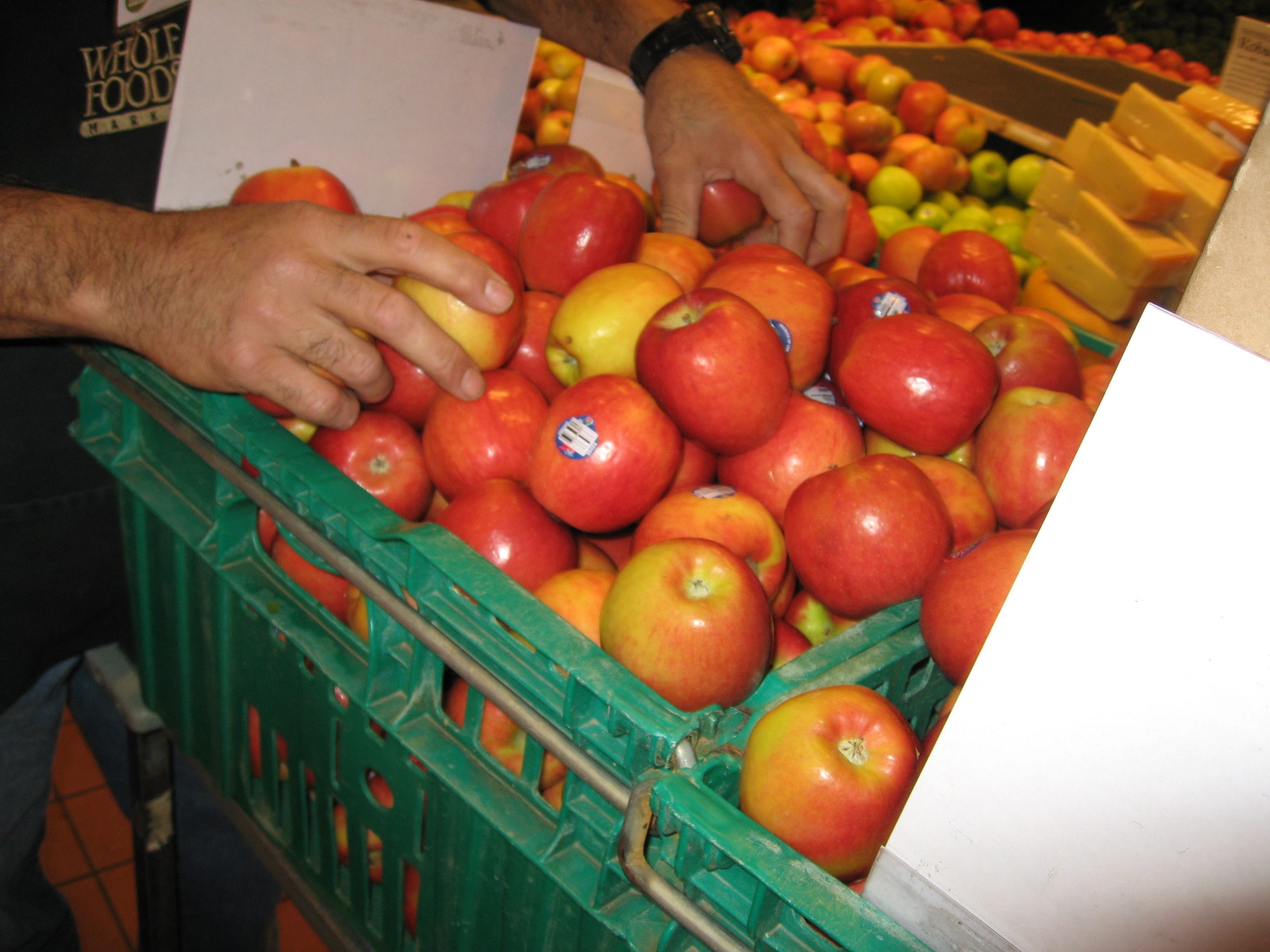
What item at the grocery store or farmers’ market is tempting and wholesome at the same time?  Well, the humble apple, for one.

What do apples do to keep the doctor away?  Nutritionist Victor Fulgoni found that eating apples improves our circulation and insulin levels.  For instance, there is a 27 percent reduction in risk factors for metabolic syndrome in those whose diets include whole-apple products, including applesauce (my favorite).

The Nobel Prize-winning poet from Chile, Pablo Neruda wrote in his “Oda la manzana” (translated by Ken Krabbenhoft):

You, apple,

are the object

of my praise.

I want to fill

my mouth

with your name.

I want to eat you whole.

Pablo Neruda has the right idea… by eating the flesh and skin of la manzana, we are getting a mix of antioxidants that work synergistically to prevent hardening of the arteries and even cancer.  Its pectin, a soluble fiber, helps lower cholesterol both in the blood and the liver.  An apple a day can also prevent glucose intolerance and insulin resistance.  Combine these health benefits with the many luscious ways to prepare apples and you can see why Johnny Appleseed preached that “fruit is next to religion.”

These fruits were first cultivated by Greeks and Romans in 300 BCE.  Johnny Appleseed, otherwise known as John Chapman, helped spread them around in the early 1800s by planting orchards in the Midwest.  Now we can find apples growing throughout the United States, with almost three million tons of them grown in Washington state alone.

Neruda, in his ode, called for even more abundance of this glorious orb:

I want

a city,

a republic,

a Mississippi River

of apples,

and I want to see

gathered on its banks

the world’s entire population

united and reunited

in the simplest act we know:

I want us to bite into an apple.


Apples for peace!  Thank you, orchards.  Thank you for your fruit–and our health.

Apples ready for eating